
The truth about problem solving


There may be valuable minerals in Greenland that could help American industry. There may be great benefits in investing US dollars in Gaza. There may be legitimate reasons to increase security for the Panama Canal.
But we don’t need to invade. All of these issues can move forward through dialogue and collaboration with those who live there. Viable solutions that work for everyone are possible.
But our President only knows one tool: coercion. And the result of threats and coercion is conflict, not solutions. Both the President and the majority party in Congress currently favor a meat ax approach to both foreign and domestic policy.
The only benefit to their approach is that it will drive us to the bottom. Then people will push back with massive resistance. According to an inspired post from Michael Moore this week, we are well on our way.
The good news is that once we hit bottom, the door will be open to seek better ways to solve our problems.
The truth is, we already know how to solve problems effectively. Our judicial system, where ordinary citizens are given evidence and then asked to determine guilt or innocence, provides a clue.
When I worked in state government, the answer to every contentious issue was to create a task force. I staffed the Solid Waste Task Force, the Aquaculture Task Force, the Sears Island Task Force and more.
Whenever a new Task Force was announced, I’d roll my eyes because these groups usually devolved to a political stalemate. We would spend weeks arguing over the wording of a final report and accomplish little else.
There is a better way. Stanford University has developed what they call “deliberative polling” which is proving far superior to task forces for moving forward.
The key is to select a diverse group---much like a jury. A cross section of people representing different ethnicities, income levels, educational attainment and geographies is ideal.
In the Stanford experiments, diverse citizen groups have found solutions to immigration, energy policy, and systemic racism.
The groups were given time to become thoroughly acquainted with the issue—from expert presenters, site tours, supporting materials and unlimited question and answer sessions. The thorough information gathering allowed participants to grasp the nuances and complexities of an issue. It diffused polarization.
Following the information gathering phase, the citizens had to craft the fairest, most viable solution(s). This is similar to jury deliberations, except that the goal is to arrive at a solution, not a verdict.
In my experience, collaborative problem solving can be even simpler. I believe any group can move an issue forward as along as one key condition is met: that every group member sincerely wants to craft a fair and viable solution. This I believe is even more important than having the exact right people in the group.
When I was serving in state government, I was the governor’s representative on a group called the Community Preservation Advisory Committee. The group’s mission was to find solutions and present them to the state legislature. Issues we tackled included building and energy codes, historic preservation of downtowns, working waterfront access, and affordable housing.
We invited both experts and ordinary people to give presentations. We queried stakeholders and toured sites. The “advisory” nature of our mission meant there was no time or political pressure, allowing us to freely gather information and bat around ideas.
We were extremely productive. We recommended a statewide uniform building and energy code which passed the legislature. We recommended a historic tax credit to incentivize restoration of historic downtowns, which also passed. We recommended a sur-tax on coastal vacation homes to fund public water access. (While not passed yet, it remains a worthy solution.)
From experience I can tell you that working with a committed group to create collaborative solutions is productive, rewarding and fun.
The Stanford participants had a similar experience. Polarization was greatly reduced and participants felt enriched by the process. As one participant said, “Having gone through the experience, I know I changed. I learned something.”
What a breath of fresh air! A process where people honestly seek solutions results in sound policies and personal growth; results intimidation and coercion can never produce. The collaborative approach should be used to solve problems everywhere!
Where can we start? The best place is right where you are. Is there a problem your homeowner’s association, nonprofit, church or town needs to solve? Perhaps you should assign a group to tackle it.
All it takes is honest engagement, authentic information gathering, and a creative space free from a pressing decision. A chair or facilitator to keep the process on track also helps.
It’s really that simple. Group problem solving is a skill we need to practice and hone if we are going to rebuild our communities and our country. Why not start now?
For further reading: two excellent books:
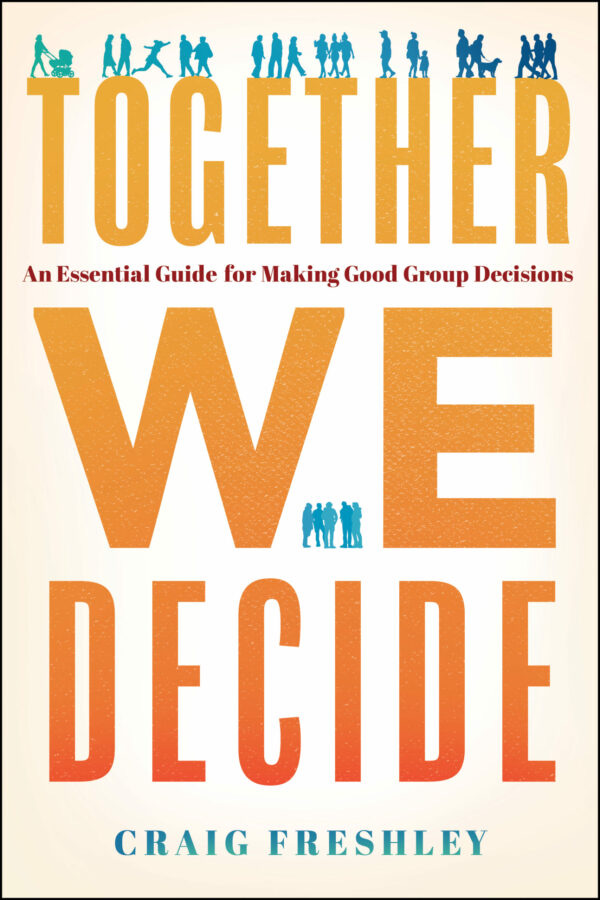
Together We Decide, An Essential Guide for Making Good Group Decisions.Written by Maine facilitator and author Craig Freshley. Craig’s insights and instructions are accessible and based on his many years of experience working with groups. I highly recommend it.
Third Millennium Thinking: Creating Sense in a World of Nonsense
By Saul Perlmutter, John Campbell and Robert MacCoun.
A physicist, a philosopher and a psychologist walk into a bar….this book is by two Berkeley and one Stanford professor. They present tools, techniques and examples to address the challenges of today’s world. I haven’t read the book, but it gets many positive reviews and is on my reading list!
Quote of the Week:
Most of all I take strength from all of you. From the idea that we get to stand side by side in this fight, not because we know we will win, but because we know we must. We are not panicking. We are organizing. And we will keep going, with all the love we can muster and some of the anger too. —Bill McKibben, founder of 350.0rg and Third Act.
Excellent piece Sue. Practical and hopeful. Ironic that listening is considered by the polarized to be
selling out. Seems that believing in the possibility of mutual benefit is a key mind seat. Know any examples of getting opposite thinkers to that beginning? Must have something to do with trust building.
Bill Gregory
Sue, the deliberate polling process is fascinating. I wonder if anyone has applied it with schools.